The 30th NSU Congress: international solidarity in action!
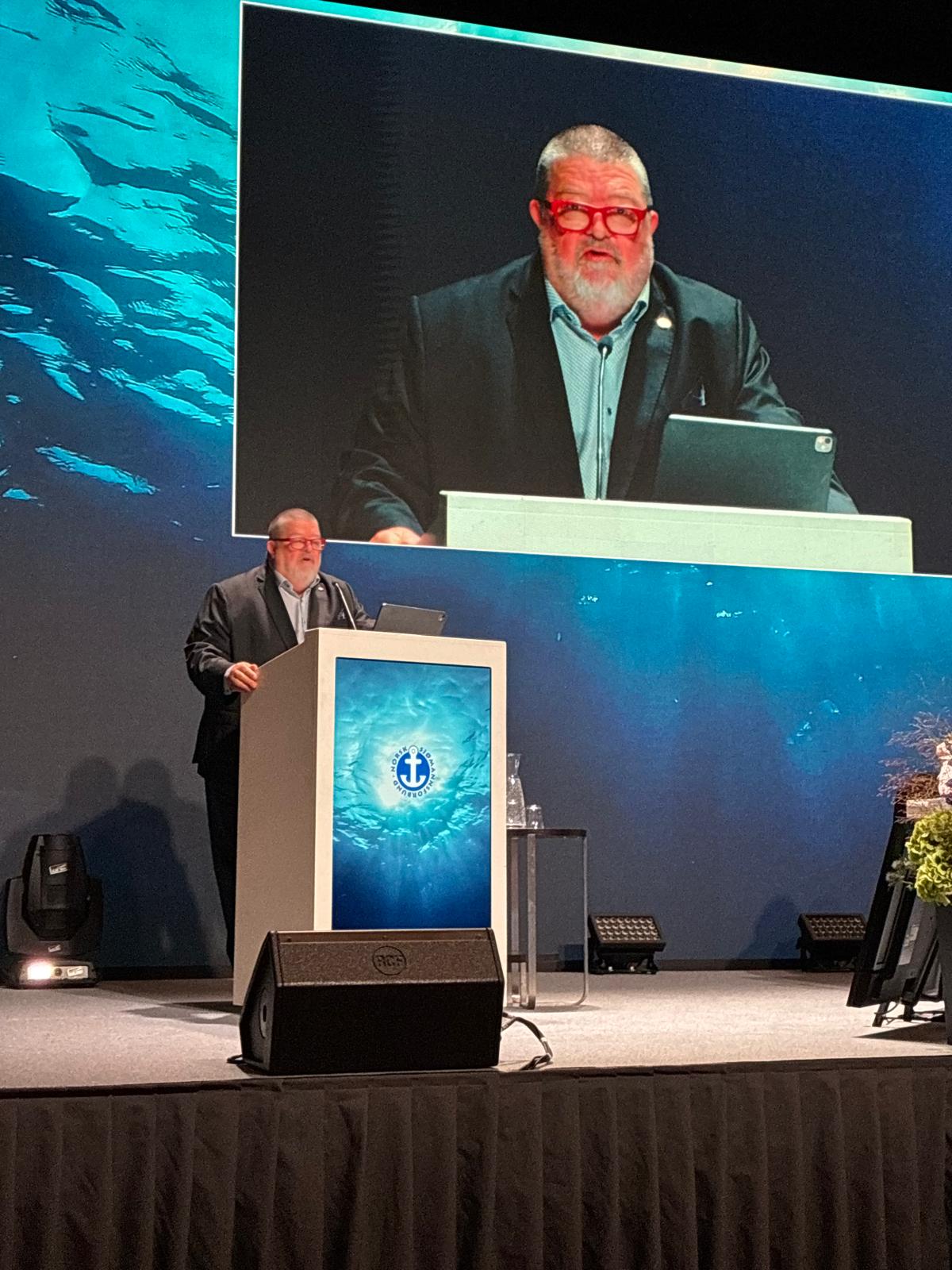
This week I am a guest at the congress of the Norwegian trade union NSU in Oslo.
During the congress I highlighted the important role played by the NSU within the international trade union movement. For many years, the NSU has been a pioneer in international cooperation and the protection of seafarers. From strong bilateral agreements and fair working conditions to safety on cruise ships, ferries and in the fishing industry: every day, the NSU makes a difference for maritime workers worldwide.
The challenges of tomorrow also call for strong trade unions. The impact of AI, the climate transition and the defence of our democratic rights make international solidarity more important than ever.
My message is clear: workers must have a say in shaping their future. And we can only achieve this by working together, across borders.
A strong NSU, a strong ITF and a strong international trade union movement. Together we are stronger! 🌍
You can read my full speech below. ↓The full speech
Frank Moreels
30th NSU Congress · Oslo, Norway
Dear comrades,
Dear friends,
I am taking the floor today at your congres, knowing that my friend and comrade, my teammate Paddy Crumlin already addressed this Congress yesterday, and that I take the floor replacing Steve Cotton. Those are big shoes to fill! And comrades, it is a real pleasure to be here with you today. Because the Norwegian Seafarers’ Union is not just another affiliated union.
NSU has been at the heart of our international solidarity for many years.
And you should be proud of that. Comrades, when we look at the world outside this hall today, it is difficult to say that everything is going well. Quite the opposite. Enormous challenges are coming our way. And today, I want to highlight three of them.
The first we deal with as transport workers is artificial intelligence.
Everyone is talking about it. The companies developing artificial intelligence are talking about it. Scientists are talking about it. Journalists are talking about it. Politicians are talking about it. And we, as trade unions, must talk about it too. Because let us be honest:
AI can change our jobs.
AI can threaten our jobs.
And AI can even make jobs disappear.
Jobs that are done by people today may tomorrow be done by algorithms and machines. And even if our jobs do not disappear, they will change. That includes the jobs of seafarers. In my country, Belgium, ships are already operating with advanced forms of automation. And around the world, work is underway on autonomous shipping.
But comrades, this is not only about ships. Trains without drivers? Automated air traffic control? A platform economy in which algorithms decide who works, when they work and how much they earn? That is no longer science fiction.
That is the world we live in today.
And that is why this debate is not only about technology. It is about power. About who decides. About who has control. About who owns our data. About privacy. And ultimately, it is also about the question:
who decides the future of our work?
Comrades, that is why we must be at the table. Not when all the decisions have already been made. Not when the technology has already been introduced.
But from the very beginning.
If we are not at the table, others – like Altman, Musk, or Bezos – will decide our future for us.
And we cannot accept that.
The second major challenge is the climate.
We can no longer avoid this issue either. The planet is warming. We see the consequences. Floods. Fires. Extreme weather conditions. Natural disasters that are becoming more frequent and more severe. And yet something remarkable is happening. Whenever we talk about climate change, transport workers are often blamed. The ships.
The planes. The trucks. Are the cause of CO2 emission So, the people who keep these sectors running are pointed with the finger. But comrades,
we are not the problem.
We are workers. We do our jobs. And if there is to be a transition, we must not be the ones who pay the price. The major economic players who have made enormous profits for years must take responsibility. So here too, the principle must be clear:
no transition over the heads of workers.
And that is precisely why the work of NSU is so important. For many years, you have helped shape the debate on a strong national maritime policy. And rightly so. Because ships, crews and maritime expertise are not luxuries.
They are strategic assets for a country.
When a crisis breaks out, when supply chains are disrupted, when countries face major challenges, they need ships. They need crews. They need maritime expertise. And that is why we need strong maritime unions.
NSU understands this.
And through the ITF, including through the Cabotage Task Force, NSU has made an important contribution to this work.
And then there is a third challenge.
Perhaps the most fundamental one.
The defence of democracy.
Comrades, We are seeing the rise of populism around the world. We are seeing the growth of far-right parties. We are seeing political forces putting democratic institutions under pressure. We are seeing attacks on press freedom. We are seeing attacks on trade unions. And in several countries, we are seeing far-right parties gaining more and more political power.
We must take this seriously. Not only because we are trade unionists. But because we know what happens when democratic rights disappear. Let us never forget one thing:
trade union freedom is a democratic right.
The right to organise is a democratic right. The right to bargain collectively is a democratic right. Press freedom is a democratic right. An independent judiciary is a democratic foundation. And without these rights, it becomes increasingly difficult for us, as trade unions, to defend our people. So, comrades:
defending democracy also means defending the labour movement.
There must be no doubt about that.
But comrades, Today I do not want to speak only about problems. Because if we look only at the problems, it is easy to become discouraged. We can lower our arms. We can say: “It is all too big.” “There is nothing we can do about it.” “Let us retreat into our own countries.” “Let us hope that it will all pass by itself.”
But that is not who we are.
We are trade unions. We are workers. And we know one thing:
alone, we can achieve little.
Together, we can achieve a great deal.
Let me give you one example.
I’ve just come back from Sri Lanka where ITF organised a conference about AI, and where 8 principles have been developped. These will be our guidelines for dealing with AI the coming years. All affilates will have a flowchart on how to deal with AI. That’s what ITF is doing, brothers and sisters! Not talking around, but doing concrete work that is useful for the affiliates.
That is why we have the ITF. That is why we have international solidarity. That is why we have each other. And that is why we have organisations like the Norwegian Seafarers’ Union. Because NSU has shown for many years what international solidarity means. You work together with unions in the countries where seafarers are recruited.
In the Philippines. In India. In Indonesia. You help build agreements that ensure that seafarers’ rights do not depend on the flag they sail under, the country where they were recruited or the place where their ship happens to be operating.
That is international solidarity in practice.
And that is exactly what the ITF stands for. But you do even more. With your actions in the cruise sector, in fisheries, the ferries, … NSU sets the standard for many other unions within the ITF.
Comrades, yes, the challenges are enormous. But our organisation is enormous too.
The ITF is strong.
But the ITF is only strong when its affiliated unions are strong. And unions are only strong when their members are organised. That is why international solidarity matters so much. That is why you matter so much.
The Norwegian Seafarers’ Union matters.
You are part of our international movement. And we are part of your movement. So let us not allow ourselves to be divided. Let us not – within ITF – spend endless time arguing amongst each other while the major challenges are standing at our door. Let us work together. Let us respect our differences. But above all, let us show what unites us.
We are workers.
We are trade unions.
We are an international labour movement.
And if we join forces— if we work together— if we refuse to be divided—
then we can make the voice of workers heard.
Then we can shape the future. Then we can defend our jobs. Then we can defend our democratic rights. Then we can achieve a just transition. And then, comrades—
we can and we will win.
Together.
Internationally.
In solidarity.
Thank you.