
Extreme heat stopped being a mere inconvenience long ago. It is a growing social problem. Year after year, heatwaves cause thousands of additional deaths in Europe, particularly among older people, the chronically ill and workers who have to perform physically demanding work outdoors. Without ambitious climate policy, that number is only likely to rise further.
And yes, that too is a question of social justice. Someone living in a spacious villa with air conditioning and a garden with a swimming pool experiences a heatwave very differently from someone living in a poorly insulated city apartment or working outdoors all day. The climate crisis does not affect everyone equally. That is precisely why the fight against global warming is not only an ecological task, but a social one. Anyone who wants to protect workers and vulnerable families must also protect the climate.
We are in the midst of an unprecedented ecological crisis. Temperatures are rising, weather patterns are becoming disrupted and ecosystems are collapsing. But the climate crisis is not only about CO emissions or melting ice caps. It is a social cris2is. A crisis that increases inequality, undermines justice and raises fundamental questions about who pays the bill.
And all too often, the answer is: the working class. The transport worker, the woman working in a port, the warehouse worker, the driver. Not the CEOs of multinationals, not the shareholders of the fossil-fuel industry. That is the social reality of climate change.
Yet the climate crisis remains every bit as urgent as it was a few years ago. Politically, however, attention appears to be waning. Since Donald Trump became President of the United States for a second time, the old mantra has returned: ‘Drill, baby, drill.’ Investment in fossil fuels is encouraged, climate measures are rolled back and renewable-energy projects are scaled down. What for years was presented as a necessary ecological transition is once again being treated as an obstacle to economic growth.
We see a similar tendency in Europe. The Green Deal had barely been approved before attempts began to weaken targets, postpone deadlines and scale back social and ecological ambitions. Under pressure from conservative forces, industrial lobbies and geopolitical uncertainty, the climate transition risks disappearing into the background once more.
Yet tackling the climate crisis is a social struggle too.
Climate Damage Does Not Affect Everyone Equally
The heaviest impact of the climate crisis falls on those with the fewest resources. Those who work in sectors with no buffer and no alternative.
Anyone standing in an unventilated warehouse feels every heatwave in their own body. Anyone who cannot afford a low-emission car pays fines or is excluded from urban zones. Anyone working in the informal economy sees their livelihood disappear with every flood, heatwave or storm.
Paul Magnette puts it sharply in La vie large: ‘Climate policy that is not socially governed increases inequality.’
Without social justice, climate policy turns into social regression. Too often, the debate is framed as though workers had to choose between their jobs and the climate, as though economic security and ecological responsibility were opposites.
That is a false choice. The real challenge is to connect climate policy with quality employment, social protection and collective investment. Workers must never become the victims of a transition they did not cause. The future does not lie in choosing between jobs and the climate, but in climate jobs that provide dignity, security and protection.
Polluters Protected, Workers Under Fire
The paradox is stark: those least responsible for climate change carry the heaviest burden. Multinationals receive emission rights, tax breaks or deadline extensions. Working people face job losses, high energy bills and insecurity - and are often blamed when they protest against the consequences of bad policy.
The financing of the climate transition is also often framed as a choice between higher costs for citizens and abandoning climate ambitions. But that too is a false dilemma.
The question is not whether resources must be found, but who should contribute them. When major polluters have made profits for years from activities that damage the climate, it is only logical that they shoulder a larger share of responsibility for the solutions. Fair climate policy starts from the principle that the broadest shoulders should carry the heaviest burden.
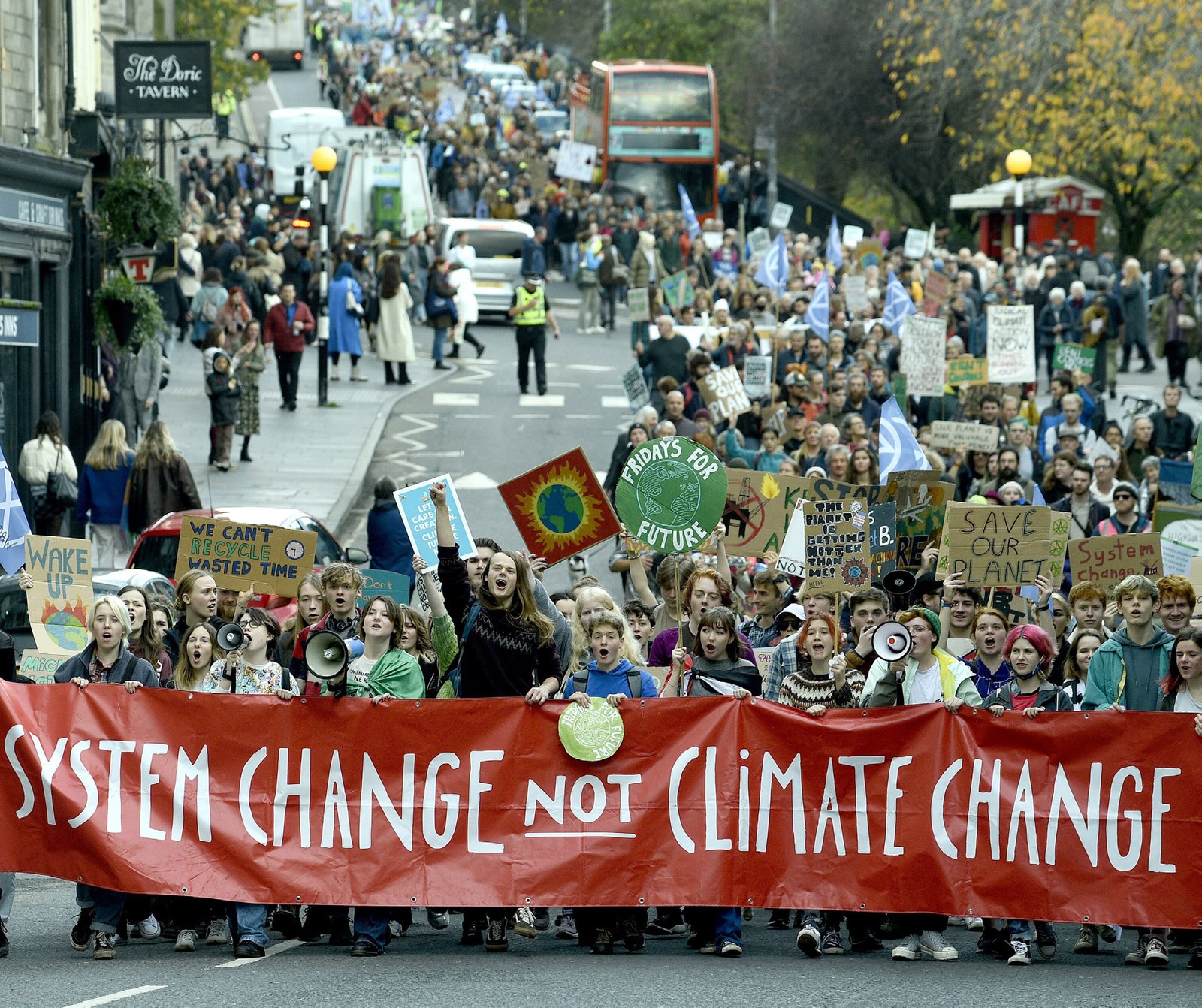
Too often, climate policy becomes a vehicle for social cutbacks: subsidies disappear, taxes rise and flexibility is imposed. Behind many political debates also lies the assumption that economic growth and sustainability are incompatible, as though societies can only become more prosperous by consuming more resources and causing more emissions. That argument is becoming increasingly untenable.
The challenge of this century is precisely to develop an economy that creates prosperity without exhausting people or the planet. An economy that invests in public transport, sustainable logistics, circular production and quality employment. Social added value, not profit maximisation, must be at its centre. We have to say clearly: a just transition does not mean people having to choose between their job and the planet. It means jobs for the planet.
Climate Policy Must Have A Social Foundation
Trade unions must therefore develop their own proactive climate vision. That means using major public investment to fund sustainable infrastructure, public transport and green logistics. It also means workers confronted with change must have rights to training, retraining and job guarantees. Trade unions must be involved in drawing up climate plans, and every measure must be assessed in advance for its social impact.
The transition must also be financed progressively, with major polluters and companies that have profited for years from fossil resources taking greater responsibility for the cost of the shift.
A green transition is only sustainable if it is also just. And justice is not an appendix. It is the core.
Those Who Make The Weakest Pay The Climate Bill Fail Twice
We cannot choose climate policy that is blind to social consequences. That would not only be unjust, it would also fail. People will only commit to the transition if they know their rights, their income and their future are protected.
That is why trade unions must lead from the front. Not by slowing climate policy down, but by broadening it. By giving it a social foundation. By saying: the planet belongs to all of us. And the future therefore cannot belong to the elite alone. The world belongs to everyone. The world belongs to all of us.
More than ever: together. For climate policy that is fair, collective and humane.