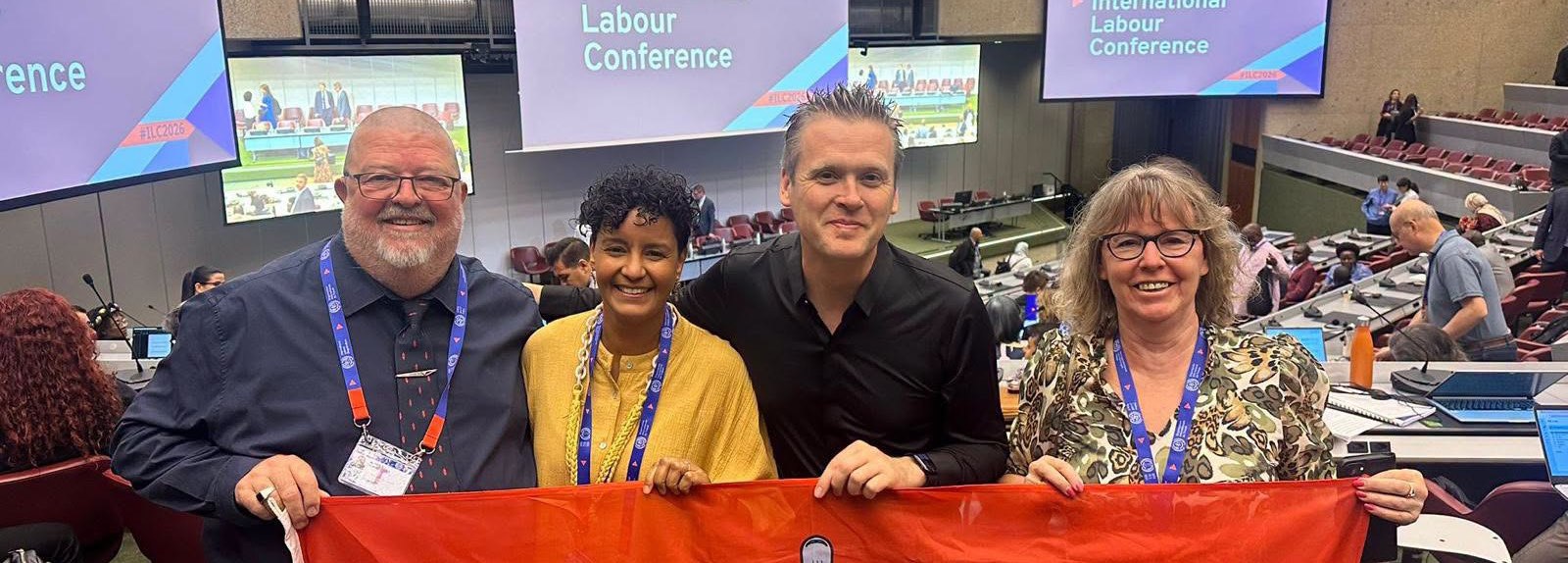
Our power lies in our connections, in solidarity across borders and in structures that allow us to work together, unite our voices and exert influence on a global scale. The ILO, the UN, the ITUC, the ETF, the ITF and the ETUC are not abstract acronyms. They are anchor points in our global struggle.
Each of these organisations has its own role. The ILO remains the global reference point for fundamental labour rights and international labour conventions. The ITUC brings trade unions from around the world together to organise joint campaigns and solidarity actions. Within transport, the ITF and ETF provide cross-border coordination and joint action. The ETUC represents workers’ interests vis-a-vis the European institutions. And in international climate negotiations, trade unions use different channels to make workers’ voices heard in discussions about the future of our planet. Multinational companies call for multinational trade unionism.
Multinationals have legal teams in three time zones, lobby groups in every parliament and tax strategies spanning dozens of states. If our countervailing power stops at the border, we will always lose.
International cooperation between trade unions is therefore not a luxury; it is part of our very reason for existing in the twenty-first century. Through these international structures, unions can do much more than express symbolic solidarity. They can help enforce minimum standards worldwide, organise joint campaigns against social dumping, defend trade union rights where they are under pressure and give workers a voice in global discussions on climate, technology and economic development.
The Role Of The ILO: Bastion And Battleground
The International Labour Organization remains one of the international labour movement’s most important historic achievements. It was founded on a fundamental insight born from the devastation of the Second World War and the social inequality that underlay it: lasting peace is impossible without social justice. Labour could never again be reduced to a purely economic issue. Workers around the world had to be protected through common social standards negotiated between governments, employers and trade unions.
That makes the ILO unique. It is one of the few multilateral institutions in which workers, through their unions, have a structural seat at the table. But that is precisely why the organisation has also become a battleground today.
Authoritarian regimes, neoliberal lobby groups and nationalist governments are increasingly trying to weaken multilateral institutions. We see the Trump administration systematically undermining international cooperation, from attacks on the World Health Organization (WHO) to reducing support for international institutions and social standards. The funding and political capacity of multilateral organisations such as the ILO have also come under pressure. The United States has failed to pay its membership contribution for two years, an amount representing 22 per cent of the regular budget.
Behind these attacks lies a broader political logic: international rules and social standards are treated as obstacles to national power politics and unrestrained market forces.
History, however, shows precisely the opposite. The ILO was created because the international community understood that social dumping, extreme inequality and exploitation ultimately lead to instability, conflict and war. Social dialogue and international labour standards are therefore not bureaucratic luxuries, but foundations of democratic societies.
Crucial conventions that improve the lives of millions of workers around the world are still negotiated within the ILO. We have already discussed the new convention on decent work in the platform economy. Another important example is Convention No. 190 on violence and harassment in the world of work. For the first time, the international community explicitly recognised that every worker has the right to a safe and dignified working environment, free from violence, sexual harassment and psychological pressure.
But progress like this never happens by itself. Every convention, every social standard and every protection is the result of years of struggle, pressure and international trade union mobilisation. Trade unions must therefore not scale back their engagement in the ILO, but strengthen it - not only through representation, but through campaigns, international pressure and visibility.
National solutions are no longer enough in a globalised economy. Multinationals operate worldwide. Platform companies bypass borders. Social dumping does not stop at national frontiers. Workers therefore need an international social contract that protects fundamental rights regardless of where people work.
Those who dismantle multilateralism ultimately dismantle international protection for workers as well.
Defending institutions such as the ILO is therefore not a diplomatic detail, but an essential part of the global struggle for democracy, decent work and social justice.
ITF And ETF: Strength In Transport
In the world of transport, the ITF globally and the ETF in Europe are central to trade union power. They provide structure, exchange and coordinated action. Think of campaigns involving Amazon, Uber and Maersk; support for striking workers in France or Poland; agreements on driving and rest times, safety and platform regulation.
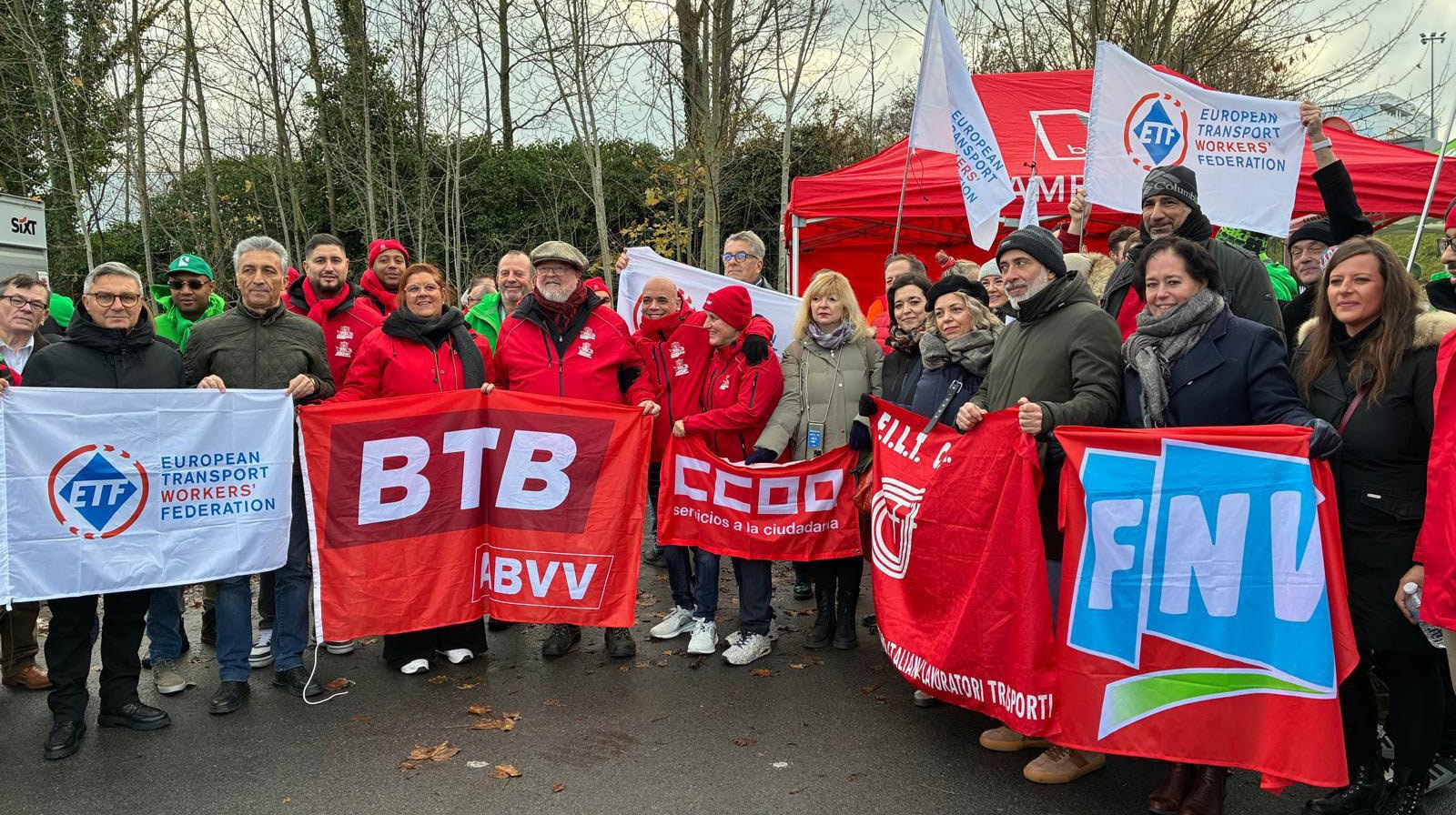
Their importance is difficult to overstate. When transport companies operate internationally, workers must be organised internationally too.
The ITF and ETF can turn local conflicts into international campaigns, share experience between countries and help prevent employers from playing workers from different countries off against one another.
One of the most visible examples in transport is undoubtedly the European Mobility Package. When the European Commission launched its initial proposals, road transport risked being liberalised even further without sufficient social protection. Drivers from Eastern and Western Europe risked being played off against one another in a race to the bottom. For many unions, the battle seemed lost before it had even begun.
But the ETF did not give up. For years, transport unions from across Europe took action in Brussels and Strasbourg. Thousands of drivers came to the European institutions to make their voices heard. At the same time, intensive lobbying of Members of the European Parliament - particularly within progressive and social-democratic groups - helped secure amendments that placed social protection at the centre.
The final result was not perfect legislation, but it was fundamentally better than the Commission’s original proposal. Without the ETF, there simply would not have been a Mobility Package that defended drivers’ interests. It is an example of how European trade union cooperation can genuinely change policy.
The ETF’s relevance is clearer than ever in the files currently on the European agenda. The federation warns, for example, about new European initiatives that threaten to weaken existing social protection under the banner of ‘simplification’. The weakening of the Due Diligence Directive, which requires respect for human rights and reduced environmental impact, and proposals such as a so-called ‘28th company regime’ could give companies more scope to evade social obligations by establishing themselves in Member States with weaker worker protection.
A second example can be found at global level. For decades, the ITF has maintained a unique network of inspectors who visit ports around the world. Their mission is simple: to check whether seafarers receive what they are entitled to.
Year after year, these inspectors carry out thousands of inspections on ships sailing under all kinds of flags. They uncover unpaid wages and abuses, and force shipowners to meet their obligations. Thanks to this system, millions of dollars in unpaid wages have been recovered for workers who might otherwise have had no protection at all.
The success of these inspectors shows that international solidarity can be more than declarations or resolutions. It can literally put money back into workers’ pockets.
But international trade union organisations must not rest on their past successes. Too often, international trade union work risks being reduced to consultation, conferences and lobbying. These tools remain important, but they are not always enough when fundamental social rights are under pressure.
The ETF faces that challenge too. In recent years, successful actions have been organised against social dumping and subcontracting. Together with EFFAT, the European Federation of Food, Agriculture and Tourism Trade Unions, and EFBWW, the European Federation of Building and Woodworkers, it organised several visible mobilisations in Strasbourg on subcontracting and the protection of workers in complex subcontracting chains.
But we also have to be candid. The European trade union movement is currently not doing enough to bring workers from different sectors onto the streets at the same time around one common issue. The ETF’s last major European mobilisation for Fair Transport dates back to 2019. Since then, the challenges have only grown: rising inequality, social dumping, platform work, artificial intelligence, geopolitical tensions and the rise of the far right.
When employers and multinationals operate internationally, unions cannot limit themselves to national action. The ETF clearly needs to start thinking bigger again.
The international trade union movement has proved in the past that global mobilisation is possible. One of the strongest examples was the struggle against apartheid in South Africa. As early as 1959, the International Confederation of Free Trade Unions (ICFTU) called for a boycott of South African products. During the 1970s and 1980s, this grew into a worldwide campaign in which affiliated unions organised action in ports, workplaces and towards governments. International pressure, economic boycotts and solidarity campaigns helped isolate the apartheid regime.
During the Cold War too, the international trade union movement managed to mobilise workers across borders.
After martial law was imposed in Poland in 1981, the ICFTU organised one of its largest international solidarity campaigns ever in support of Solidarność and its leader Lech Wałęsa. Trade unions in Europe, North America and other parts of the world organised demonstrations, workplace solidarity actions, fundraising and political pressure campaigns. For millions of workers, Solidarność became a symbol of the struggle for democracy and trade union freedom.
The same happened in support of persecuted trade unionists in Chile under Pinochet, in South Korea, Turkey and South Africa. Through international weeks of protest, joint petitions, actions at embassies and coordinated campaigns, unions made clear that an attack on one trade union is an attack on us all.
These examples show that international solidarity is not a utopia. It has existed. It has worked. And it has helped make history. The question is not whether worldwide trade union mobilisation is possible.
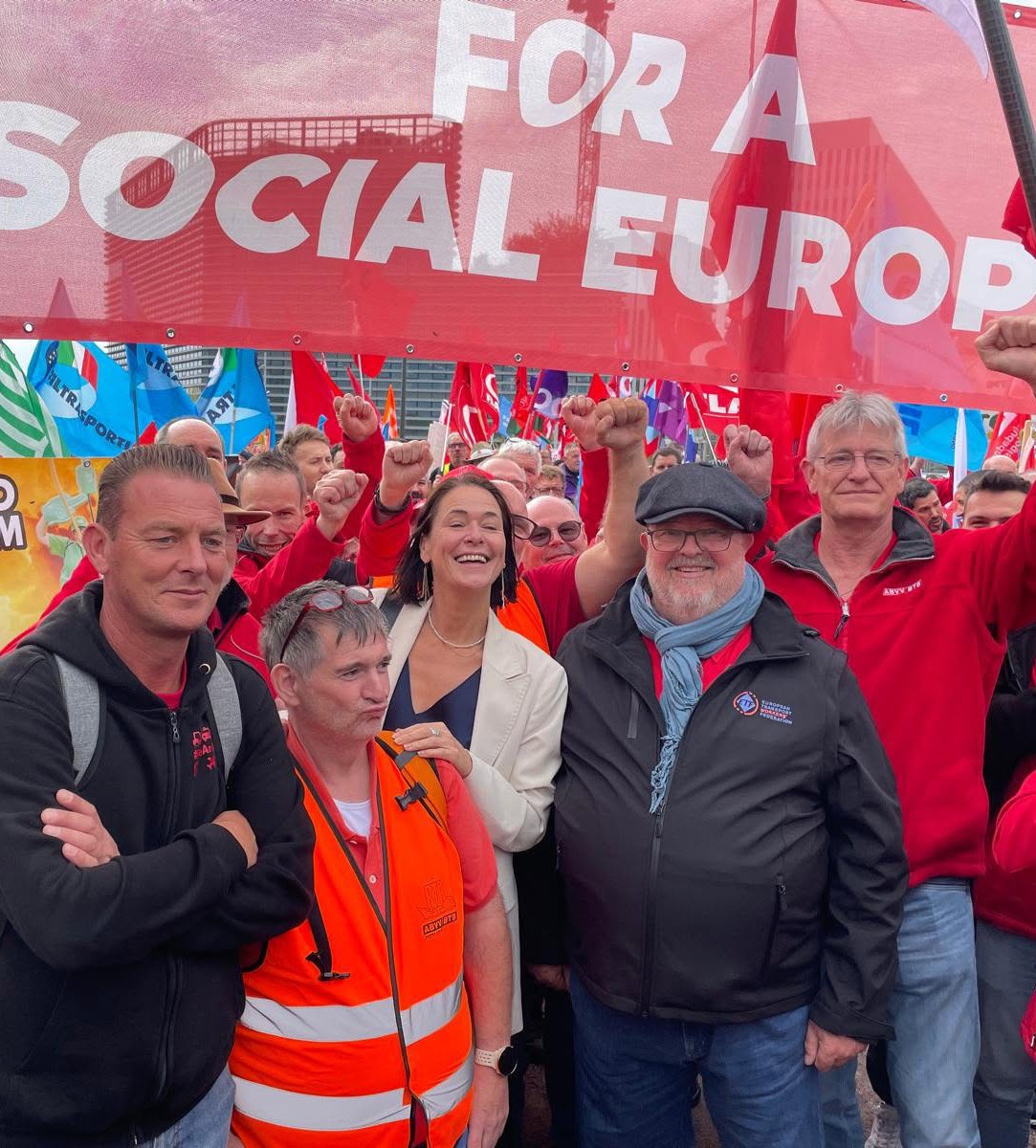
The question is why we do not show the same ambition again today. Why not organise a worldwide ITUC day of action for decent work? A coordinated international mobilisation against social dumping? Or a joint trade union campaign on the regulation of artificial intelligence, the protection of democracy or a just climate transition?
The technology exists. The networks exist. The challenges are global. What is often missing is the political will to use that power in practice. Perhaps the international trade union movement needs to learn to dream again on the scale at which capital now operates. If multinationals can organise globally, why shouldn’t workers?
European trade union unity under pressure
Within the European Union, a dangerous tension is emerging. Economic rules, budgetary discipline and market mechanisms remain firmly embedded in European policy, while social rights and labour protection increasingly risk being pushed into the background. Too much emphasis is placed on competitiveness, flexibility and liberalisation, while social cohesion and worker protection come under pressure.
The European trade union movement must formulate a powerful response. Not by retreating into national protectionism, but through joint action, international campaigns and a clear social alternative to the current economic model.
The ETUC must therefore not become merely a consultation structure or a talking shop. It must be a genuine mobilising force that connects workers across borders and organises social countervailing power at European level. As already noted, multinationals have long operated internationally. If unions remain fragmented along national lines, workers will inevitably lose ground.
That does not mean we should be blind to the shortcomings of the European Union. Belgian political scientist Hendrik Vos has repeatedly pointed to the limitations, slowness and internal contradictions of the European project. Europe is often complex, technocratic and too strongly shaped by economic orthodoxy. Social progress rarely happens automatically.
At the same time, Vos stresses something else: despite all its flaws, the European Union remains one of the strongest examples of multilateral cooperation in modern history. It has made peace, cooperation and common minimum social standards possible on a continent once torn apart by war, nationalism and dictatorships.
That is precisely why trade unions must not leave Europe to technocrats, lobby groups or nationalists who want to dismantle the project from within. We must help reinvent Europe with labour, social justice and democratic solidarity at its heart. Not less Europe, but a more social Europe. Not a Union that protects markets alone, but one that protects workers too.
Without a strong social pillar, Europe risks losing its legitimacy. And it is precisely in that vacuum that the far right, distrust and division grow.
As trade unionists, we must make an unequivocally pro-European choice, but with far stronger social priorities than Europe has today. We must not go along with populist anti-European chatter or the dismantling of the European idea.
European unification was a European project from the outset, from the moment the Italian socialist Altiero Spinelli wrote down the foundations of European unity while imprisoned under Mussolini’s fascist regime.
But words are not enough. As trade unions, we need to take to the streets of Europe again. At European level, a demonstration at every European summit could make the voice of working people heard all the way into the rooms where Europe’s real decisions are ultimately shaped. The ETUC should reconnect with the tradition that was upheld under the leadership of John Monks and Emilio Gabaglio.
A European Investment Strategy As An Answer To The Crisis Of Neoliberalism
Paul Magnette, President of Belgium’s Parti Socialiste, puts the issue sharply in his political essay La prospérité pour tous (March 2026).
Europe is at a turning point. For decades, we were told that free trade, market forces and budgetary discipline would automatically produce growth, prosperity and stability. Today, we can see the limits of that model.
While the United States and China invest massively in industry, technology, energy and strategic infrastructure, Europe has too often locked itself into a logic of austerity, liberalisation and underinvestment.
The consequences are visible. Europe is losing ground in innovation, industrial production and technological development. We have become dependent on foreign suppliers for essential raw materials, energy, semiconductors, medicines and strategic technologies. That dependence is not only an economic problem, but also a democratic and geopolitical risk. Whoever no longer controls their productive capacity ultimately loses part of their political autonomy as well.
Europe therefore needs a new investment strategy. Not as a temporary crisis measure, but as a structural change of course. The European Union must once again become an actor that invests, plans and sets direction. That means investing in industry, research, energy, mobility, digitalisation and public infrastructure. It also means no longer treating the climate transition as a cost, but as an economic opportunity and a social project.
Too often, the ecological transition is presented as a burden on citizens and businesses. In reality, failing to invest is far more expensive. Studies show that the economic damage caused by climate change over the coming decades will be many times greater than the resources needed today to reduce emissions. Failing to invest means higher energy costs, greater climate damage, more social inequality and a loss of competitiveness.
The challenge is to link the climate transition to ambitious industrial policy. Europe must once again produce what it needs. Renewable energy, battery technology, rail infrastructure, the circular economy and strategic industries must form the core of a new model of economic development. This will create not only economic growth, but also quality employment and greater strategic autonomy.
Such an investment agenda does require Europe to abandon some old dogmas. Current budgetary rules restrict Member States’ ability to invest for the long term. Governments are often forced to postpone investment at precisely the moment it is most necessary. That is economically short-sighted. Investment in infrastructure, energy, education and innovation is not expenditure that burdens future generations; it creates the conditions for future prosperity.
Europe therefore needs a powerful common investment instrument, financed through European resources and joint borrowing. The experience of the European recovery plan after the Covid crisis showed that joint investment is possible when the political will exists. What was possible in a crisis must also be possible to secure Europe’s industrial and ecological future.
An investment strategy cannot be separated from social justice. Today, European Member States still compete too often through tax advantages, wage pressure and social cutbacks. This downward competition weakens both public finances and social protection. Europe needs greater solidarity, more tax coordination and common minimum social standards. Economic integration can only be sustainable when it is accompanied by social progress.

The financing of those investments must also be fair. While workers and consumers carry most of the tax burden, large fortunes and multinational companies often avoid making a proportionate contribution.
Fairer taxation, with greater contributions from capital income, large fortunes and exceptional profits, is not only a matter of justice, but of economic efficiency too.
This vision is part of a broader evolution within European social democracy. More and more progressive forces recognise that markets alone cannot solve all the challenges of the twenty-first century. The climate crisis, geopolitical tensions, the technological revolution and growing inequality require an active state and an ambitious European project.
The choice facing Europe is fundamental. Either we cling to a model of underinvestment and dependence, risking further economic decline and social division, or we choose a European Union that invests in its industry, its workers, its infrastructure and its future. A Europe that regains its economic sovereignty and uses the ecological transition as a lever for social progress. That is not only an economic necessity, but a democratic task.
International Solidarity Is Not A Slogan. It Is A Strategy
Without multilateralism, capital wins. Without international cooperation, we lose strength. Only by connecting our struggles can we ensure that social standards continue to apply on a global scale.
And let us be clear: those who undermine the multilateral order - from Trump to Putin, from Orbán to the tech billionaires - do not do so out of democratic concern, but because they want to break workers’ rights.
More than ever: together. Across borders. Against the global race to the bottom. For global social progress.