Our clothes travel around the world without difficulty. Capital moves even faster. Raw materials, production, profits and financial flows move effortlessly from one continent to another. Yet when we talk about solidarity, workers’ rights and social protection, we sometimes still behave as though the national border were their natural endpoint. For a trade union, that can never be enough.
International trade unionism is not an add-on to our work in Belgium. It follows directly from it. A worker negotiating wages and working conditions here is part of the same economic reality as a worker elsewhere who is used to make production cheaper.
When social rights are weakened in one country, pressure increases on workers in others.
When a multinational plays different sites off against one another, there is little point in workers trying to win that game separately. Solidarity therefore has a very practical meaning: better working conditions elsewhere protect our working conditions here, and stronger unions in other countries increase our bargaining power too. Preventing workers from being played off against each other means building international countervailing power.
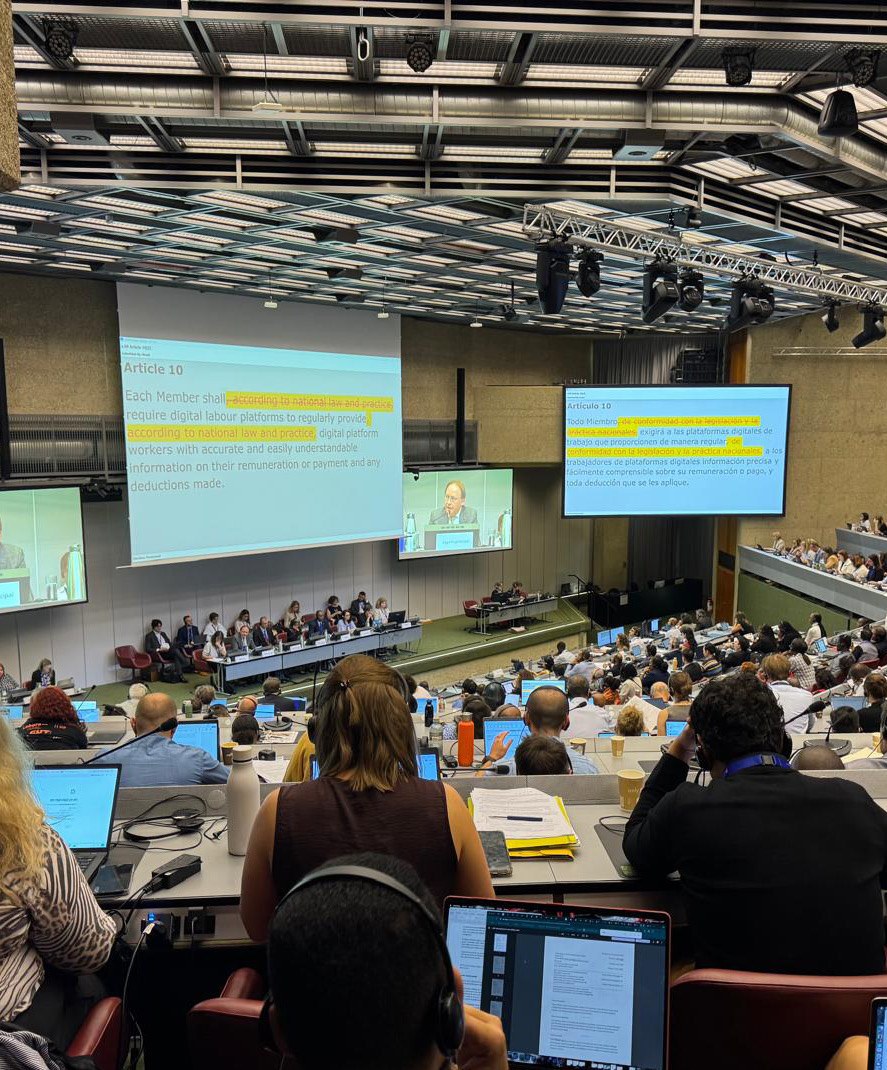
For me, that is also where the enduring importance of the International Labour Organization lies. The ILO starts from a principle that sounds simple but must constantly be defended: labour is not a commodity. A worker is more than a cost in an international production chain.
Freedom of association, collective bargaining, safe working conditions and decent work must not depend on where someone was born. Without international standards, another dynamic emerges almost automatically. Countries compete through lower wages, weaker social protection and fewer rules. Companies can threaten to relocate to places where labour is cheaper. Workers are then told they must make sacrifices in order to remain competitive. Globalisation becomes a contest in which everyone is pushed downwards while those at the top become ever more mobile.
The same logic is what makes multilateralism so important today. There are legitimate frustrations with it. The United Nations is often slow, international agreements are not always enforced and great powers apply rules selectively. Gaza confronts us in an especially painful way with the enormous distance that can exist between international law and what people experience on the ground. My conclusion is not that we need international institutions less. Quite the opposite: without multilateralism we do not get a world without rules, but a world in which power determines the rules. Major economic and military players may be able to survive in such a world. Workers, small countries and vulnerable populations are far less able to do so.

The international legal order must therefore become stronger, more consistent and more credible. A human right does not change its meaning because it is violated by a friendly country. An ILO convention must not become a recommendation that applies only when it is economically convenient. UN principles lose their meaning when governments enthusiastically defend them in one conflict and relativise them in another.
Europe must ask itself the same question. European solidarity can mean much more than an internal market and a common currency. Its real value for workers emerges when social rights are raised upwards. A Belgian worker has nothing to gain from poverty wages elsewhere in Europe. Sooner or later, those differences will be used to put pressure on their own wages, job or working conditions. A stronger social Europe therefore protects workers from competition between workers. It can establish minimum rights, fight social dumping, regulate multinationals and prevent countries from competing with ever lower taxes and ever cheaper labour.
That is precisely where the trade union movement must exert influence internationally. We also live at a time when democracy itself is once again under pressure. Authoritarian leaders are gaining ground and the far right is building international networks while selling nationalism to its voters. These movements understand remarkably well that political power can be organised across borders. Trade unions must have at least the same ambition. Because for me, international trade unionism is ultimately not first and foremost about institutions, congresses or structures, but about something much more fundamental: refusing to let workers be played off against each other.
A worker in Belgium does not become stronger because a worker in Benin, Poland or Bangladesh has fewer rights. A trade union gains nothing when a union elsewhere is weakened. Social progress that remains accessible to only one group will sooner or later come under pressure for that group as well. I took that thought away from Cotonou, but it applies just as much in Brussels, Geneva or any factory floor.
Our economy has long been international. So have our companies. So have our financial markets. And the great challenges of our time are even less capable of being contained within national borders. It would be strange if solidarity were the one thing that stopped there. The international trade union movement therefore needs not a smaller role, but a much larger one. Not because borders will disappear tomorrow, but because workers only become stronger when their rights do not end at those borders.