114th Session of the International Labour Conference
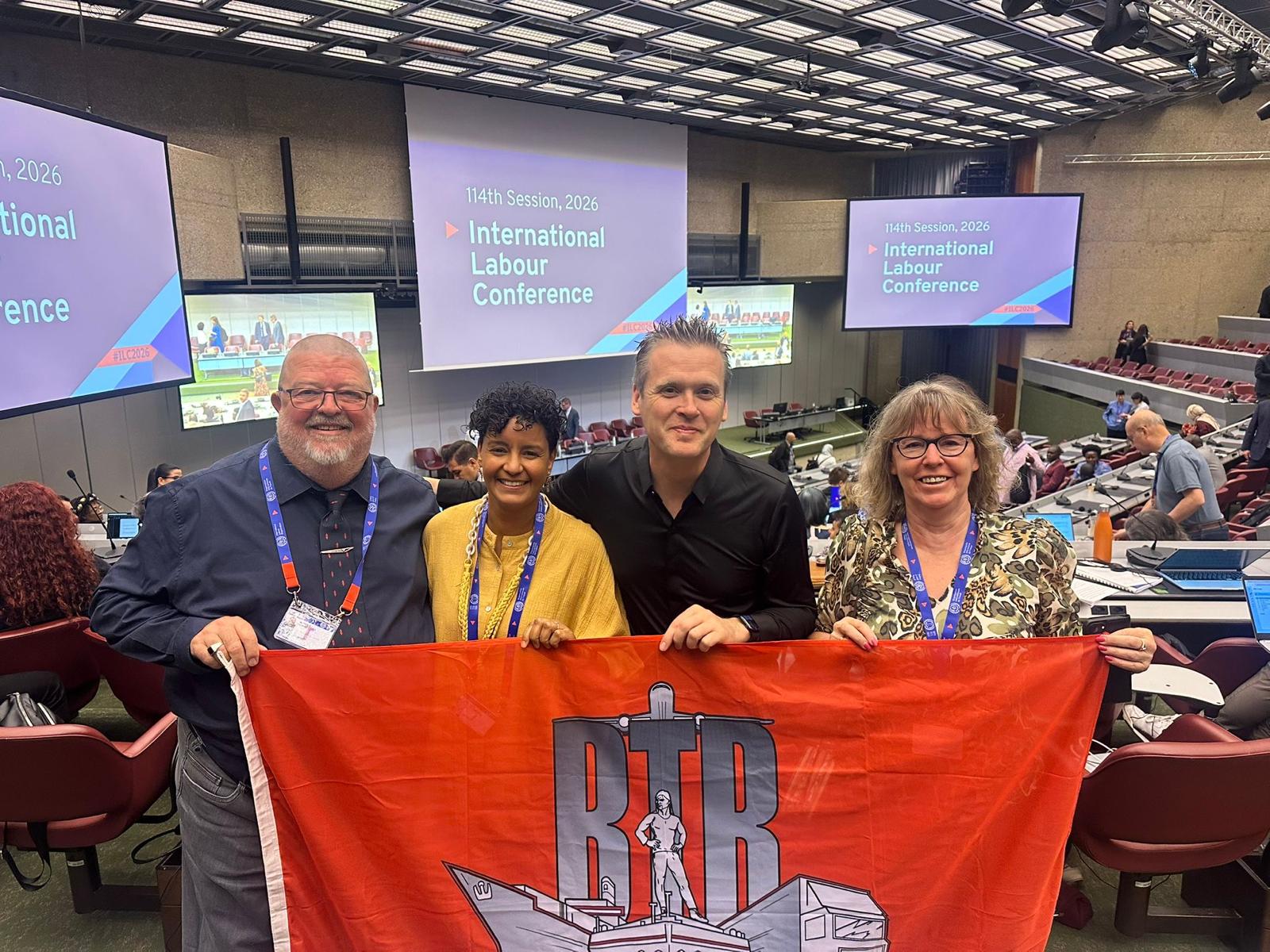
Bert Engelaar, president of our Belgian confederation ABVV spoke at the ILO conference on decent work in the platform economy.
In his speech, he emphasized that the technological revolution is challenging our vision of society.
You can read his full speech below.
The full speech
Bert Engelaar
114th International Labour Conference
Ladies and gentlemen,
There are times when the world moves very fast without always knowing where it is going. Screens flash.
Decisions are made. Silently.
Somewhere, a worker receives an automated message changing their schedule.
A nurse discovers that software calculates how much time she can spend with a patient.
A driver waits for an app to assign him a few more fares so he can pay his rent.
This is today’s world, where artificial intelligence is playing an ever-greater role. Not tomorrow. Right now.
It is already permeating businesses, government departments and digital platforms.
Yes, this technology can achieve extraordinary things. Reduce certain tedious tasks.
Create new jobs. Improve working conditions.
But one question remains: what becomes of human beings in all this?
Workers are already familiar with this story.
They were promised that every technological revolution would bring greater freedom. Then the pace of work picked up.
Fatigue became the norm.
The fear of losing one’s job has become widespread.
Technical progress has never guaranteed human progress.
An algorithm does not understand the anxiety of a parent who fears for their job.
A digital platform does not know the silence of a worker who comes home too exhausted to speak to their children.
That is why this debate is so important.
Because beyond the technology, it is our vision of society that is at stake.
The Director-General’s report makes this clear: artificial intelligence is not a force of nature, but the result of human choices, economic and political choices.
This means one fundamental thing: we can still decide. Decide on the limits.
To decide on safeguards.
Because when there are no rules, it is always the most vulnerable who pay the price.
Even today, workers find their working hours determined by opaque systems, their performance constantly monitored, and their movements monitored.
That is why we need clear rules. Transparent ones. Binding ones.
Not tomorrow. Now.
Then there is another reality.
In many countries, the voice of workers is seen as a nuisance. Trade union freedoms are under threat.
Collective bargaining is under attack.
Social dialogue is treated as an obstacle.
Yet, change imposed without dialogue always produces the same result: fear, anger and rejection.
Workers must be at the negotiating table. Within companies.
In the sectors.
In international institutions.
Not to simply accept decisions made elsewhere.
But to play a real part in the choices that will shape their future. The ILO’s role is therefore essential.
In this ever-faster-moving world, someone must still remind us of a fundamental truth:
work is not a commodity. It never will be.
And to this end, the ILO has valuable assets. Social dialogue.
Tripartism.
International standards.
In a world that is becoming increasingly opaque, these tools may well be the last lights still burning.
But it must be said:
the current regulatory framework remains inadequate.
Artificial intelligence is now transforming almost every aspect of working life: recruitment, salaries, health, surveillance, the right to disconnect, protection against unfair dismissal.
That is why any future standard on artificial intelligence must be ambitious. It must provide concrete protection for workers.
Preventing technological innovation from becoming a social step backwards disguised as modernity.
Because, ultimately, the question is very simple:
do we still want a humane world?
A world where technology helps human beings to live better lives.
Or a world where human beings end up living at the pace of machines. The danger is very real.
The danger of a colder, lonelier, more brutal.
A society where everything becomes measurable except what matters most: dignity, justice, humanity.
So yes, this new chapter in technology must be one of social justice and decent work.
A profoundly human chapter.
A chapter in which no one is left behind in the shadow of machines.
Thank you for your attention.