A World on Fire – Europe Must Choose
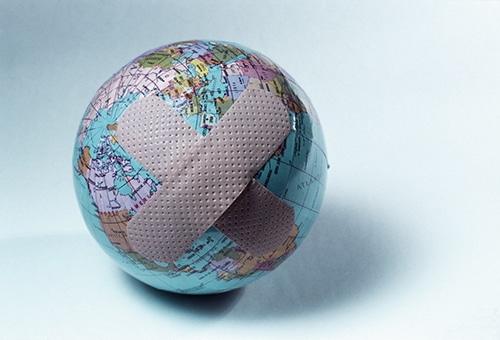
Anyone following the news today cannot ignore the reality: the world is on fire.
The war in Ukraine continues to drag on, directly affecting Europe and its people. In the Middle East, violence flares up again and again, with devastating consequences for civilians and for regional stability. Our attention is focused on Ukraine, Gaza, and Iran—but at the same time, conflicts are multiplying across the globe. Sudan, the Democratic Republic of Congo, the Sahel… they risk slipping off the radar. In 2024 alone, experts counted 61 active conflict zones worldwide. The number of armed conflicts is rising.
This must stop. We must be clear: trade unions stand for peace. Stop the war.
At the same time, we see how major powers—Russia, China, and the United States—are increasingly asserting themselves through brute geopolitical force. International law is too often being pushed aside in favour of power politics. When leaders openly express territorial ambitions or put pressure on other countries, the very foundations of international law begin to erode. What once seemed self-evident—peace, stability, respect for borders—has become fragile again.
We are witnessing a dangerous normalization of aggressive rhetoric and actions. This is not the kind of world we accept. This must stop.
For workers in Belgium—and across Europe—these conflicts are not distant events. Wars and geopolitical tensions have immediate and very concrete consequences.
Today, around 20,000 seafarers are effectively blocked in the Strait of Hormuz. This is not just a number—it is about people: workers trapped at sea, facing uncertainty about their safety, their working conditions, and even their basic needs. There are real concerns about food supplies on board, access to medical care, and the possibility of crew changes. At the same time, their situation disrupts global supply chains: deliveries are delayed, essential goods—including food and medical supplies—are affected, and pressure on the entire system increases. Airports have also come under attack, and kerosene shortages are already being reported. The impact is immediate and systemic.
Transport workers are once again on the frontline.
When fuel prices rise, transport costs increase. When routes become unsafe, workers are exposed to direct danger. When supply chains are disrupted, pressure mounts on wages and working conditions. Social dumping risks intensifying, waiting times in ports increase, and insecurity becomes part of the job.
This is the direct fallout of geopolitical instability—and it is transport workers who carry the burden.
More broadly, workers feel the consequences every day: at the fuel pump, in their energy bills, and in the rising cost of basic goods. While companies may still have buffers, it is workers who absorb the first and hardest shocks. Protecting purchasing power is therefore essential. Wage protection mechanisms are not a luxury—they are a necessity and must be defended.
For trade unions, the priority is clear: workers must not be forced to pay for crises they did not create.
But let us also be honest: no single country, certainly not a small one, can face these global challenges alone.
This is a moment of truth for Europe—both for political leaders and for trade unions.
In a world where authoritarian leaders and nationalist forces are gaining ground, Europe cannot afford division. Our democracy, our social rights, and our welfare systems are not givens. They are the result of decades of struggle, cooperation, and solidarity.
Today, these achievements are under threat—from outside pressures and from within. Right-wing and populist movements seek to dismantle the European project and pit people against one another. But those who believe that national isolation offers protection are mistaken.
Only a strong, united, and social Europe can defend our democracy and protect our prosperity. This means more cooperation, more solidarity, and a clear commitment to democratic values. A stronger social Europe, an end to deregulation and liberalisation, and a halt to social dumping.
Because in a world on fire, neutrality is not an option—Europe must choose: solidarity over division, democracy over power politics, and workers over profit.