Time for trade unions to make a global fist
The war in Iran: Transport workers are the first victims
The war in Iran, escalated by the U.S. and Israel, is not just a regional conflict—it is a global disaster for workers, and transport workers are the first victims. And even though there is currently a fragile and unstable ‘ceasefire’ in place for two weeks, everyone realises that this could turn into open warfare again tomorrow or the day after.
The Strait of Hormuz, a critical chokepoint for 20% of the world’s oil, is and stays a war zone. Seafarers are trapped in dangerous conditions, with ships rerouted, delayed, or stranded as missiles and drones strike nearby. The International Transport Workers’ Federation (ITF) reports that seafarers near the Strait of Hormuz face “unprecedented risks,” including being stuck for weeks without supplies, pay, or safe passage. Many are unable to disembark or receive medical care, and their mental and physical health is deteriorating rapidly.
Aviation crews are also under siege. Major Middle Eastern airports—including Dubai, the world’s busiest international hub—have been closed or damaged by attacks, leaving aircraft and crews stranded out of position and disrupting airline schedules worldwide. The Association of Flight Attendants-CWA warns of “damage to airports, accidental or deliberate targeting of commercial aircraft, network disruption, and increased global security risk and spiraling violence.” Drone attacks have caused injuries to airport workers, and thousands of flights have been cancelled, leaving crews and passengers stranded for days. The war has created a “massive hole in global airspace,” forcing airlines to reroute or cancel services, adding hours to flight times, and pushing fuel and operational costs to unsustainable levels.
The consequences ripple across the globe. In Sri Lanka, where petroleum accounts for a quarter of imports, fuel rationing is back: motorists are limited to 15–20 liters per week, and prices have surged by 33% since the war began. The Philippines, which imports 98% of its oil from the Middle East, has declared a national energy emergency. Fuel prices have more than doubled, reserves are down to 45 days, and airlines are cutting routes to conserve fuel. At the same time, Russia’s Vladimir Putin is exploiting the global fuel shortage and soaring prices to reposition himself on the world stage, offering negotiations to dependent countries while indirectly financing the ongoing war in Ukraine through increased energy revenues. Globally, gasoline prices have jumped by 20–30% in the U.S. and even more in Europe and Asia, with Brent crude up 60% since the conflict started. In Belgium, my own country, energy prices went up with 35 % since the war started. Although energy prices are falling as a result of the temporary ceasefire, the global energy market remains volatile. With a single ill-considered post on ‘Truth Social’, President Trump could destabilise the stock markets and cause oil and gas prices to soar.
It is clear, workers are the ones that will pay the cost of this war!
Multinationals use war as a pretext to attack workers’ rights
The war is also being used as a pretext by multinationals to break long-standing collective bargaining agreements (CBAs). In Kenya, a global supply chain player has already announced breaking up a CBA, citing the war as justification. This is not an isolated case. Across Africa, the conflict is disrupting supply chains, causing fuel shortages, and pushing up transport costs by 15–20%. The International Rescue Committee warns that the war is pushing humanitarian operations to a breaking point, with soaring fuel prices and supply chain delays choking life-saving services. In Kenya, fuel rationing is already underway, and the consequences are immediate and severe, especially for matatu drivers and farm supply chains.
The U.S. people say “No Kings”
But there is hope! Also the American people have had enough. On March 28, 2026, over 8 million people took to the streets in more than 3,300 events across all 50 states, making it the largest single-day protest in U.S. history. The “No Kings” demonstrations, supported by the AFL-CIO and hundreds of unions, were a direct response to Trump’s authoritarianism, the Iran war, democratic backsliding, and the suppression of workers’ rights. AFL-CIO President Liz Shuler declared, “No Kings is about standing up to the guy in the White House. But No Kings also means tearing down an economy by and for the billionaires—and instead, building it for working people”.
The far right: A global threat to workers and democracy
While the war rages, the far right is on the march. The ITUC’s 2025 Global Rights Index reveals a devastating truth: workers’ rights are in free fall, with Europe and the Americas recording their worst scores since records began. Only seven countries now respect workers’ rights fully, while 39 are rated at the lowest level—meaning no guarantee of rights at all. The ITUC warns of a “coordinated assault by the ultra-rich and their political allies,” rigging economies against working people and undermining democracy.
In Europe, far-right parties now govern or share power in Italy, Hungary, Finland, Slovakia, … , with significant gains in Germany, France, and Austria. These forces are united in their hostility to workers’ rights, democratic institutions, and the rule of law.
A Call for action: Protect workers, end the war, defeat the far right
The global labor movement cannot stand by while workers bear the brunt of crises not of their making. Governments must act now:
- End the war in Iran. The international community, led by workers and their unions, want more than just a temporary and unstable ceasefire; we want the guns to fall silent for good and for diplomacy to take over. Seafarers, aviation crews, and transport workers must not be collateral damage in a conflict fueled by geopolitical ambition
- Stop multinationals from using the war as an excuse to break CBAs and attack workers’ rights. The case of Kenya shows how quickly the war can be weaponized against labor. Unions must expose and resist these tactics everywhere.
- Control price levels and guarantee wages. Governments must intervene to prevent runaway inflation, ensure affordable essentials, and protect workers’ incomes from the ravages of war and corporate greed.
- Unite against the far right. Trade unions must overcome ideological and national divisions to present a common front. The ITF, ITUC, and all affiliated unions must lead the charge, developing a shared agenda that protects workers’ rights, reshapes global supply chains, and holds governments accountable.
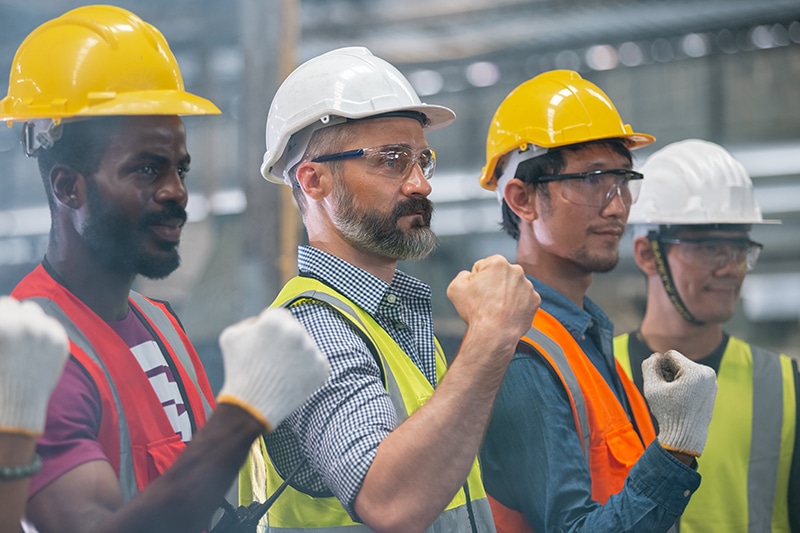
The ITUC’s findings are a wake-up call: democracy and workers’ rights are under attack worldwide. The alternative is clear: if we do not stand together, we will be picked off one by one, our rights eroded, our voices silenced. The global far right is organized, determined, and on the march. It is time for trade unions to make a global fist—and for governments to act before it is too late.